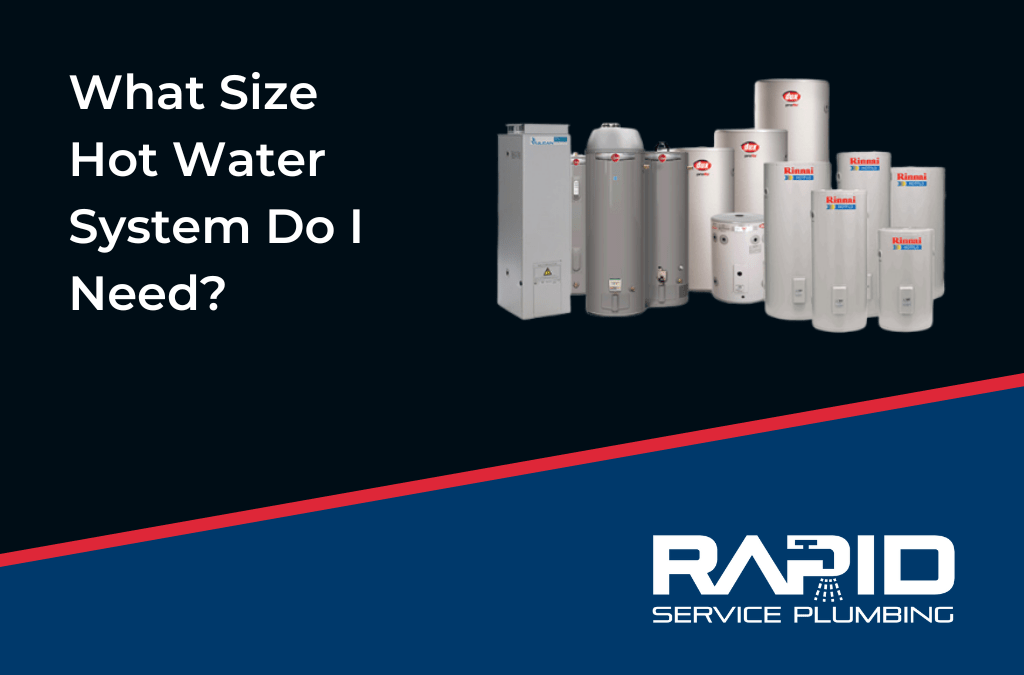
A hot shower or bath isn’t just a hygienic luxury, it’s great for calming the muscles and the mind, improving sleep, reducing inflammation and joint pain and improving circulation. And it’s not just about the bath or shower, either – because you also rely on your hot water system to wash the dishes, clothes, for cooking, cleaning and more. But do you keep running out of water, day after day? Knowing what size hot water system to buy in the first place is the best way to avoid that cold and frustrating problem.
What size hot water system do I need?
Updating your hot water system so you don’t keep getting stuck under a cold stream of water? There are even a few other reasons to ensure you make the right choice from all of those various hot water system sizes:
Don’t run out of water: If the tank, power or capacity size is too small, there won’t be enough pre-heated and stored hot water to get you from one main heating cycle to the next.
Be energy & cost-efficient: It’s not just about avoiding a hot water system that is too small – too big for your household’s needs, and you’ll just be wasting money on both the bigger ticket price and the ongoing energy costs.
Make your system last: If you ask an underpowered instantaneous hot water system to work too hard each day, it’ll dramatically speed up the wear and tear process. To keep those maintenance, repair and replacement bills low, a well-sized system is a must.
Convinced that choosing wisely from all those hot water system sizes is critical to keep those steaming showers flowing? Our Sydney plumbers have come up with a step-by-step guide on how to get a head-start on matching the right-sized hot water system to your property, family and needs:
1. What’s your overall demand?
Did you know each person in your home uses somewhere between 50-75 litres of hot water each and every day? For a family of four, that’s 200-300 litres per day – a helpful early guide to the sort of system capacity and tank size you’ll need. However, some people have big full baths, and very long showers – whilst others have short showers or even cold showers!
Also factor in the number of bathrooms in your home, as well as the non-bathing appliances that use hot water.
2. Try a hot water calculator
Most hot water system manufacturers or plumbers will be able to refer you to their own or third-party sizing charts and hot water usage calculators that are quite helpful for matching your home & lifestyle to the right system.
3. What flow/delivery rate do you need?
As well as tank capacity, two other critical considerations for hot water system sizes are the flow and the delivery rates. That’s basically the rate at which hot water is capable of being delivered from the system into your home and out of the taps at any given time. Get it wrong, and your shower could be a trickle rather than a satisfying flow, especially when another hot tap or outlet is turned on elsewhere in the home. As a rough guide:
Gas hot water systems‘ flow rate is typically a little higher – up to 40 litres a minute on average
Depending on the capacity, instant hot water systems have variable flow rates but the average is 10-32 litres per minute.
The water pressure in your area can affect the hot water flow rate.
We’ll help you choose hot water system sizes
However, it’s also important to consult with a hot water system plumber before deciding on the right hot water size, because you’ll also need to factor in the hot water system installation, the available energy sources, ongoing maintenance considerations and the best brands and warranties.
And here at Rapid Service Plumbing, we’ve installed, repaired and worked on so many different properties and hot water technologies that we can easily recommend the perfect hot water type, size, and model for your home & budget – no worries! For a no-obligation consultation & quote with a $0 call-out fee all across Sydney and beyond, get in touch with Rapid Service Plumbing’s hot water specialists today.
Have you just stepped out of the shower and all you got was a pathetic trickle? Is the cold water at the pressure you expect, but every time you turn on that hot tap nothing much happens? If it’s taking longer than your patience can bear to fill up that bath, that’s called low hot water pressure – but what causes it, and what can you do about it? Let’s take a deep dive into low hot water pressure:
What causes hot water low pressure?
To be honest, you’re probably going to need a local Sydney plumber either way – because hot water low pressure is most likely going to be traced to your hot water system. For example, it could be:
Sediment build-up: Don’t forget, the hot water coming out of your taps isn’t pure H2O. It’s also full of certain minerals that, over time, can turn into sediment that then builds up in your hot water system – and affects the way that hot water flows into your home.
Clogged/leaking pipes: It’s also very common that the pipes and fittings in and around that hot water system, or the plumbing it feeds, have become clogged by these mineral deposits as well. Your hot water supply pipes are also prone to the same sorts of plumbing issues that affect your cold plumbing pipes, too, like leaks – that can obviously cause low-flow problems.
Bad valves: Valves play a critical role in your home plumbing – especially with that hot water system. To cut a long story short, if those valves can’t fully open, the hot water won’t flow as well as it should.
No hot water pressure? Try these 4 checks
Do you have low or no hot water pressure at your place? The best advice is to get in touch as soon as you can with a licensed plumber. Why’s that? Because they’ll know exactly what to do to diagnose and resolve the issue in full compliance with regulations and without doing the sort of DIY damage that these professionals so often have to come and fix anyone – at extra expense to you!
But while you’re waiting for them to arrive, you could always check:
1. The cold pressure
First things first: is it really no hot water pressure you’re struggling with, or no water pressure at all? If the flow from the cold taps is as pathetic as it is from the hot taps, you can rule out the hot water system.
2. Check the shut-off valve
If the hot water system valves are the culprit, the leading candidate is probably the shut-off valve. So check whether it’s fully open or looking in good condition.
But it could also be these 3 offending valves:
Pressure-reducing valve: Find it near the main water supply line
Tempering valve: It’s found on the system’s hot water outlet
Check valve: Also located on the hot water outlet, a malfunctioning one may be allowing hot water to flow back into the system rather than out of it.
3. Check for sediment
If sediment build-up has ground your hot water pressure to a halt, a full system flush can help. Look up how to do it, but basically, all you have to do is completely drain all of the existing water out of your system and then allow it to completely fill up again once you restore the power.
4. Check for leaks
Give the tank, the pipes, the fittings and the valves a check for any signs of leaks. Because even a minor hot water system leak can keep depriving your system of water to such a degree that you end up with low hot water pressure in whole house.
Call us when you have low hot water pressure
Still struggling with that poor hot water pressure? If you’ve tried our 4 DIY checks, it’s time to get the best brains, experience and tools on the job – and the easiest way to do that all across Sydney & beyond is by giving the friendly team at Rapid Service Plumbing a shout. We’ve helped thousands of Sydneysiders just like you with fully-guaranteed workmanship and all the best tools, parts and hot water system repair expertise, so call Rapid Service Plumbing today.
Is your hot water system playing up? It might just blow your mind, but the average Australian plumber will work on literally hundreds of misbehaving hot water systems each and every year – because it’s one of the most common call-outs. Systems that produce only cold showers, noisy units that churn out discoloured water, strange noises, gas or electricity supply issues – they’re all super-common. But perhaps the most alarming and serious of all the common problems is a leaking hot water system.
A hot water system leak is a big deal
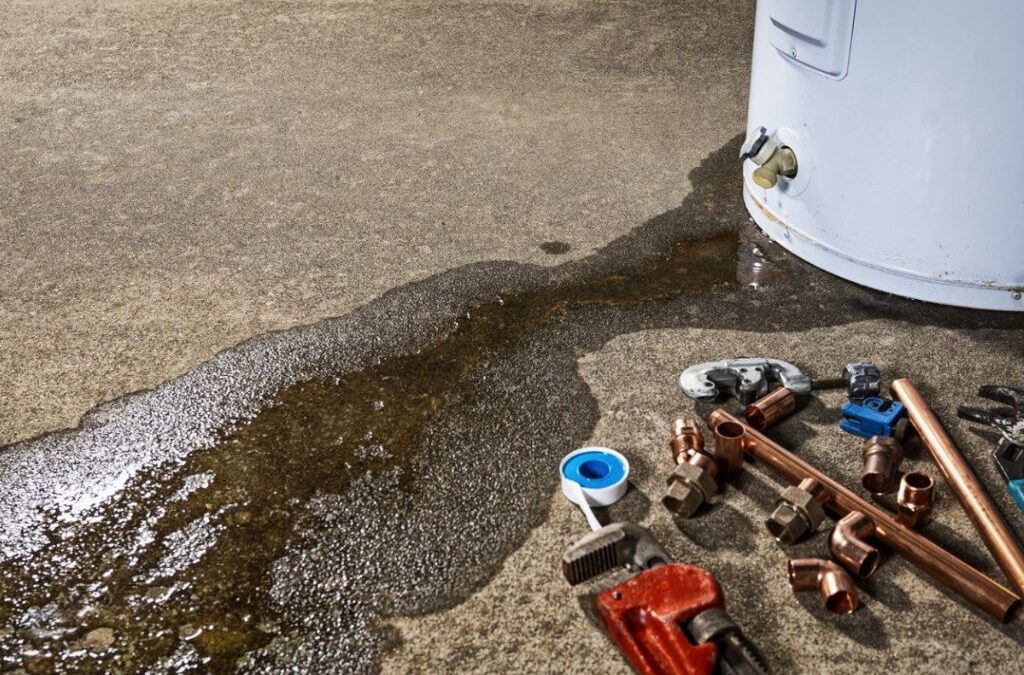
So what should you do if you notice your hot water system leaking? It may seem like just a few drops, or that a more serious leak of harmless is not really a big deal, but bear in mind that a hot water cylinder leaking water can cause:
Water damage: Leaking water anywhere in or near your home can damage your floors, walls, ceilings, promote the growth of harmful mould and bacteria – and even damage your building’s very foundations.
Big bills: It’s not just that extra water you’ll have to pay for, but also more gas or electricity as your system works overtime to compensate for the constantly-leaking water. And if you just stand back and ignore a minor leak, it could become a much bigger one – costing you even more in repairs or full system replacement.
Electrocution risk: Remember, your hot water system is also an electronic device – and we all know that water and power can have fatal consequences if they get together in an unintended way. If that leak gets near the heating element or the thermostat, the next problem could be a deadly ‘zap!’
Risk of explosion: If the leak – or the underlying cause – is extreme, immense pressure can build up inside the tank to such an extent that it can even explode.
It is therefore critical to recognise that a hot water system needs to be dealt with straight away, and by none other than you – even before your emergency plumber in Sydney can get to your place. Is your hot water service leaking? If you’re wondering how to fix a leaking hot water system, here’s what to do:
1. Turn off the power
Sure, a leaking hot water system is a soggy problem – but let’s not start mixing that water with its energy source or any nearby electronics and wiring, shall we? So no matter what its type is – gas, electricity or solar – it’s time to switch it off. You can do this even without touching it at your home’s main switchboard, and if it’s powered by gas, turn off the supply at the main valve.
2. Turn off the water
Let’s not make the problem any worse by adding more water to the system. So, to be extra careful, turn off the water supply valve at the actual hot water system as well as at the mains control.
3. Turn on the hot taps
If it’s a slow leak, it’s going to keep happening in an uncontrolled and potentially very damaging way until that tank is completely empty. You can therefore fast-forward the process and control where most of the stored water goes by turning on the hot taps inside your home. Once it’s all gone down the drain, there’s nothing left to leak.
4. Identify the problem
You could and probably should, of course, leave this step to your friendly licensed plumber, who will know exactly how to diagnose and hopefully repair the problem. But while you’re waiting for them to arrive, consider that the culprit could be:
Faulty valves
Tank corrosion
Plumbing connection leak
Loose element bolts
Worn gasket.
5. Document the damage
If you think you might be needing to lodge an insurance or warranty claim, also take the opportunity to take as many photos as you can both of the misbehaving hot water system and any damage it may already have caused.
Hot water service leaking? Call the Pros
Has your friendly local hot water plumber arrived yet to deal with your hot water leak? Here at Rapid Service Plumbing, we’ll rapidly diagnose the problem, replace a part to implement a hot water repair, or recommend full system replacement from one of the most trusted hot water brands across Sydney & beyond. It may be the perfect opportunity to make the switch to an instantaneous hot water system, which obviously will have no tank at all that can start leaking in the future, or you could switch energy source or upgrade to the latest and most energy-efficient technology with all the modern bells and whistles.
Is your hot water leaking? Remember, the most trusted local fast response Sydney plumbers team here at Rapid Service Plumbing is on duty 24/7, so don’t ignore it, give us a shout today – and we’ll do the rest.
Have you arrived home to your beloved abode only to discover that it absolutely stinks? If it’s coming from the drain, the offensive odour invading your nostrils is hydrogen sulphide, produced when bacteria feasts on the gunk that is bunging up your plumbing pipes. And apart from just stinking up a storm, those smelly drains can actually give you a headache, make you feel weak, irritate your eyes and upset your stomach.
Your smelly drains may also be caused by:
Rotting food
The growth of mould
Sewer/pipe venting problems
Leaks, corrosion and other plumbing problems
Drain flies
Tree roots & more.
How to stop a smelly drain
If your drains stink, it’s important to restore tranquillity and health to your home as soon as possible – and you might even get away with not having to call your friendly local Sydney plumber! Why not try one, some or all of the following:
1. Baking soda
You may already know that baking soda mixed with vinegar is great for fizzing up a storm and unblocking your sink or bath drain. The even better news is that the chemical reactions also neutralise those foul odours, so:
Pour your mix down the drain
Seal the drain with the plug for 15 minutes
Flush with almost-boiling water.
2. P-trap re-fill
It’s possible the problem is an empty P-trap, whose job is to contain a pocket of water that acts as a barrier between your nose and those foul and toxic pipe gases. Re-filling it is as easy as running the tap for a while, but an empty P-trap alone only really explains smelly drains that have been inactive for some time.
3. Try bleach
Another effective smelly drain deodoriser is bleach – and concocting the remedial brew is really easy. Just fill the sink, drop in a full cup of bleach, and carefully let the brew drain at the speed of gravity. Another potential drain deodoriser is mineral oil, but unlike bleach, this won’t actually also help to loosen up the clog or the stinking debris.
Stop smelly drains by preventing them
The best way to cure stinking drains, of course, is to ensure that they never even stink in the first place – and that will require some easy and regular maintenance before you even encounter this foul-smelling problem. So every month or so, try:
Pouring an almost-boiling kettle of water down the drain
Pouring a preventative baking soda plus white vinegar mix down there
Keep any garbage disposal units clean & clear
Using a strong commercial drain cleaner
Turning on any and all unused taps at your place.
Also avoid pouring any oils, fats and chunky food scraps down your drain, and consider at least an annual drain inspection and professional drain cleaning by your friendly local plumber.
We know how to stop drains from smelling
It’s also possible that your drain is already too clogged and potentially even damaged by your stinky problem – or that the issue was caused by a pre-existing plumbing problem that now needs some urgent attention. If that sounds like it may be the case at your place, or you just want a professional to deal with and deodorise your foul-smelling drains, the friendly and fully-licensed team at Rapid Service Plumbing will be delighted to assist.
We are the 24 hour emergency plumber service Sydney really trusts, so to remove that peg from your nose and deal with your smelly drains and much, much more, give Rapid Service Plumbing a call right now.
When it comes to those millions of litres of stormwater that are collected by your roof, channelled into your gutters and stormwater drains and into the community system, you might think it’s all very straightforward. But when considering who is responsible for storm water drains, the importance actually has two distinct and critical parts:
Protecting your home and family from damage & health issues
Protecting your entire community.
And that’s precisely why the question of who is responsible for stormwater drains NSW wide all gets a little murky – because who, precisely, is responsible for what in our great state?
But before we answer that explicitly, it’s crucial to understand that while the weather in Sydney is awesome from a global perspective, our climate and topography actually make stormwater flooding issues a really big deal for everyone. Because whatever water doesn’t effectively make its way from the tip of your roof into the community system will end up somewhere else – like the street or your neighbour’s place.
So if you’re seeking a quick answer to ‘who is responsible for the storm water drain on my property’, here’s the quick answer: YOU!
Your stormwater responsibility NSW-wide
Actually, while there are common themes from a state and even country-wide perspective, it is the individual local councils that actually outline your particular stormwater responsibilities. But if you’re looking for a general Sydney and NSW perspective regarding your responsibilities as a property owner, here they are:
1. It’s your responsibility
If the water falls on your roof, or elsewhere on your property, you – and only you – own the problem in the vast majority of cases.
2. It’s your property’s stormwater system
Remember, you own your property – and that includes your roof, gutters, downpipes, drains, inlet pits, and every other part of the stormwater infrastructure within the boundaries of your land.
3. You must maintain it
And with that ownership of everything outlined in #2 means you acknowledge that your system has not only been council approved but is also:
However, as well as dealing with your own stormwater, you might also be required to accept natural overland flow from either nearby or adjoining public land or your neighbours’ properties. So if you’re one of these downstream properties, you cannot put up any walls, fences or other barriers that interfere with that stormwater.
And if there’s an easement on your property, you’ll also need to make sure this is maintained and debris-free, as well.
5. What about other buildings?
Does your place have sheds and other buildings separate from the main house? Well, these types of buildings and structures will have to feature their own stormwater drainage systems too – and they’ll also need to be properly connected to the kerb or another community discharge point.
What if you breach neighbours water runoff law NSW?
If you let any of these responsibilities slip, council officers could soon be on your case to investigate further. These investigations are normally triggered by a complaint from a neighbour, who will typically have been asked to provide evidence of the problem like photos. However, the council may also tell the complainant to try talking it out with you face-to-face before escalating the investigation and potentially taking action.
As for the council’s responsibilities, they are basically charged with maintaining every aspect of the community system EXCEPT what’s going on at your property – although they may intervene to help out with any easements.
Masters in stormwater responsibility Sydney wide
Need to know more? You’re in luck because our team of plumbers Sydney wide at Rapid Service Plumbing are renowned masters of Sydney stormwater drainage solutions. For advice, repairs, full stormwater system installations and much, much more, get in touch with Rapid Service Plumbing today and we’d be delighted to help with an obligation-free quote.
It’s not hard to spot a blocked bathtub drain. After a bath, you pull the plug – and not a lot happens at all! But maybe a blocked bath is simply looming. Perhaps you can hear weird gurgling, or something smells off. Discovering a bath drain blocked can really ruin your day, but before calling a Sydney plumber, there are a few things you might like to try first:
6 ways to unblock a bath drain
So let’s give this a go! Make sure you’re at least a little bit handy with some do-it-yourself plumbing – and now let’s get stuck in.
1. Use your hand
If your first reaction is ‘ew’, move further down the list. But all too often, it’s just a giant lump of gross scum, hair and soap – so pull it out!
2. Use a coat hanger
Your local blocked drain plumber has all the right tools and equipment – but occasionally, all you need to do is straighten out a wire coat hanger. Make sure the hook is at the bottom, poke it down the plughole, give it a twist and see how much gunk you can fish out.
3. Use a plunger
You might actually like to try this at #2, but we assume that maybe you’d done it before you tried anything else. Ensure it’s a ‘cup’ plunger that is appropriate for any standard bathroom drain blocked by gunk, and:
Make sure the cup is submerged in water
Block any other nearby drain openings if possible
Keep the plunger handle vertical for a perfect seal
Don’t give up at least for a few minutes of hard work!
4. Use a drain snake
Again, your trusty plumber will have much better gear than this. But you can grab a hand-held, non-motorised plumber’s snake (or auger) from the hardware store very cheaply, and – unlike the coat hanger – it’s actually designed precisely for this purpose.
5. Use baking soda
Actually, mix it up with white vinegar and the fizzy result can loosen the gross bathroom drainage blockage just enough for it to work its way down the pipes. Follow up with an almost-boiling full kettle of very hot water.
6. Use harsh chemicals
We mention this one with hesitation because chemical drain cleaners not necessarily very good for your drains or for you, but they can certainly be more powerful than baking soda. Just remember to be super-careful and sparing with the harsh chemicals.
Bathroom drain blocked? We can help!
Have you saved yourself a few bucks by not having to call the plumber? No? Well, there’s still no reason to worry – because the friendly, fully-licensed and highly experienced team at Rapid Service Plumbing is only ever just around the corner. We service the entire Sydney metropolitan region and beyond including Canterbury-Bankstown, City of Sydney, Inner West, Eastern Suburbs, Hills District and Sutherland Shire. We provide upfront pricing, and we guarantee the quality of our workmanship.
So don’t throw that plunger across the room when a blocked bath is giving you grief – and instead call the talented team of fully-licensed Sydney plumbers right here at Rapid Service Plumbing. Give us a shout today!
When you turn off a tap, does it sound like someone is literally whacking your pipes with a hammer? It’s no surprise where the term ‘water hammer’ comes from – but understanding how to fix water hammer is a lot more difficult.
What causes water hammer?
Most common in areas of above-average water pressure or where the property’s water pipes are ageing, it’s an alarming sound for a very good reason – think of it like an actual alarm, alerting you to a problem. It’s actually not hard to understand the phenomenon, which is more technically referred to as ‘hydraulic shock, at all. Your water pipes also consist of valves, whose job is to suddenly stop the flow of water when you or an appliance requests it. Also common with today’s mixer taps, which can stop the flow in an instant flick of the lever, water hammer is simply the physics-based result of creating a sudden surge in water pressure that triggers a pressure wave – which we detect as a highly-concerning ‘hammering’ of your pipes.
And if you cringe when you hear that water hammering, your instincts are 100% correct – because it gradually chips away at your pipes and eventually leads to leaks and damage to the pipes, valves and fittings. In severe cases, water hammer that is bad enough can even trigger an instant pipe burst.
What else do you need to know about water hammer? We’ve got all the answers:
1. What are the dangers of water hammer?
Your pipes, joints, valves and other water pipe-related plumbing infrastructure are all at risk – but did you know it can even damage the appliances, fittings, seals and other equipment supplied by or connected to those pipes? Worse still, a devastating pipe explosion can even cause physical injury, or cause hazardous fluids to spill out.
2. What are the signs of water hammer?
The hammering is the obvious one! You’ll hear it either as a repetitive series of hammers in the worst cases, but the most damaging instances can actually be a single loud BANG, perhaps followed by less severe rattling. But in really serious cases, you could even notice connections that have rattled loose, or evidence of a water pipe leak.
3. How can water hammer be prevented?
Quite often, simply turning taps on and off more carefully, or opening all of the water valves in your plumbing system in a single session, can be enough to get rid of some of the air pockets that can cause simple water hammering. You can also consider simply turning off taps half-way, installing more or better wall insulation around the pipes, installing limiting valves to reduce your system’s overall water pressure, or replacing your taps for ones with more progressive valves.
4. How to solve water hammer?
You may need to call a plumber! They may be able to do a variety of things that you cannot do yourself – especially considering that most plumbing work at home needs to be done by a fully-licensed plumber anyway. But it can take experience, skill and specialised equipment to:
Reduce water pressure below 500kPa (the Australian maximum) with limiting valves
Believe it or not, there are plenty of other ways in which Rapid Service Plumbing can diagnose, minimise or eradicate your water hammer problem, too – we’ll just need to check out the problem and then get straight to work! We can quickly dispatch an emergency plumber 24/7 for serious plumbing problems, all of our workmanship is fully guaranteed and we’ll always let you know the price before getting stuck in! Give the friendly and fully-licensed local Sydney plumbers at Rapid Service Plumbing a call today!
Gas – the cleanest burning of the hydrocarbons – is abundant, affordable and makes our lives better, easier and more comfortable. Whether you’re connected to mains natural gas or you use LPG bottles, it’s how we heat and cool our homes, power our ovens and cooktops, fire up the BBQ and much, much more.
At the same time, it’s important to recognise that working with gas is dangerous – very, very dangerous! Gas can explode or trigger a fire, cylinders can overheat, pipes can leak, and carbon monoxide poisoning can be fatal. To regulate gas fitting and gas service safety in New South Wales and other Australian jurisdictions, the gas compliance certificate system plays a vital and mandatory role.
But what are the ins and outs of the gas compliance certificate NSW? Let’s take a deep dive:
FAQ: Gas certificate of compliance NSW
In a nutshell, the gas certificate of compliance is an official record that whatever work a fully-licensed gas fitter has carried out at your place has been done and tested properly. Often in the form of a physical plate attached to a gas installation, licensed gasfitters also need to lodge a paper copy of that certificate with NSW Fair Trading within 5 days.
Apart from gas installations, the following types of gas fitting work will also require a certificate of compliance:
Work on gas pipework
Installing flue pipes
Natural gas to LPG conversions (and vice versa).
Q: What gas fitting work requires a NSW certificate of compliance?
A: The system applies to all work on gas installations that are connected to a gas network.
Q: Are there any gas-related works that do not require a certificate?
A: If your gasfitter is repairing or carrying out maintenance on a gas appliance, a new certificate may not be required if the appliance is not being modified – like if a new part is simply being installed.
Q: What does the gasfitter need to do to approve & ratify the certificate?
A: Within 5 days of finishing the gas works at your place, your licensed gasfitter needs to:
Carry out full safety testing on the installation/work
Give a copy of the certificate to you
Lodge a copy of the certificate to the gas network operator
Keep a copy of the gas compliance certificate for 5 years
Lodge a copy of the certificate on the MyInspections gateway.
Q: What information is on the gas certificate of compliance NSW?
Q: Are there penalties for gas compliance certificate breaches?
A: Yes! They range from warnings to expiration notices, disciplinary interviews – all the way up to legal action under the relevant legislation.
Need help understanding gas compliance certificates?
Here at Rapid Service Plumbing, we know every ‘dotted i’ and ‘crossed t’ of the entire gas fitting world – because our local Sydney plumbers are also fully-licensed gasfitters! Rest assured, if you give our highly experienced service technicians a call for any plumbing or gas-related work, they’ll handle every single aspect of your gas compliance responsibilities.
Whether you’re in Seaforth, West Pymble, Summer Hill, North Kellyville or any other suburb of Sydney, our services ensure your gas systems meet NSW compliance standards. So sit back, stop worrying, and give the friendly Rapid Service Plumbing team a call today.
We all know what a hot water system is: it’s the clever technology that makes our showers and baths so steaming and enjoyable. But did you know that up to 25% or more of the average home’s energy costs are spent heating up that water? With that in mind, it’s a good idea to brush up on the main types of hot water systems Australia-wide, so you get the best bang for your buck and lifestyle.
Just 2 hot water system types in Australia
It may seem like there are many, many types of hot water systems out there – but there are actually just two main ones:
1. Storage/tank systems
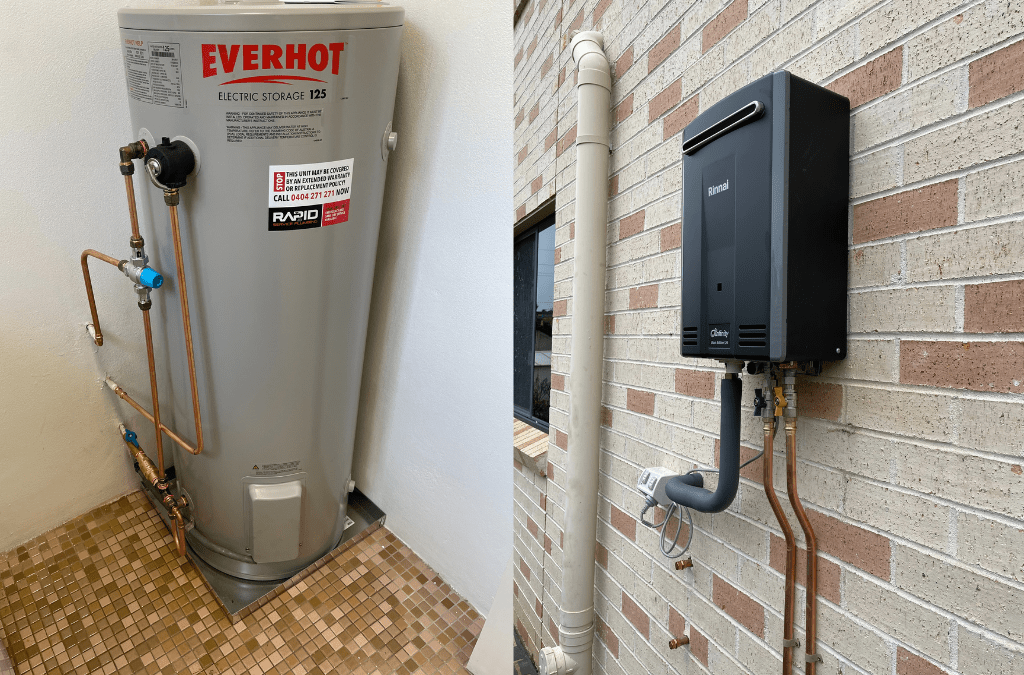
If you’re old enough to remember life before the popular, sleek instantaneous (or continuous flow) hot water system types of today, then you’ll be very familiar with the tank-based system – still the most common type of hot water system in the developed world.
Essentially, the tank – of various sizes – stores the pre-heated water so that it’s ready to be delivered to your hot tap when you turn it on.
The insulated tanks are made of metal that is sometimes glass or enamel lined, as that stored water contains many minerals that speed up the process of corrosion – a major cause of storage tank system failure and leaks. Most tank-based systems also feature a sacrificial anode rod that will attract the corrosion away from the tank and need to be replaced now and then.
The most affordable tank-based systems are typically the most traditional electric element-heated hot water heaters on the market, although the slightly more expensive-to-buy but efficient-to-run gas-powered tank systems are also very popular for those with natural gas connections or LPG bottles.
Tank systems are also paired with popular home solar power setups and the ultra-modern ‘heat pump’ hot water technology, which still uses electricity but is arguably the most efficient hot water system as it extracts heat energy from the ambient air – like a fridge in reverse.
2. Instantaneous/continuous-flow systems
Also referred to as the ‘tankless’ hot water systems, these are the slick units that are normally attached to the outside of a home – although indoor installations are also possible, making it a particularly tidy setup indeed. The gas-powered hot water units, however, require sufficient ventilation.
For around the same price as a typical tank system, the big benefit of the instantaneous types of hot water systems is right there in the name – because the hot water is almost ‘instant’ when you turn on the tap and you’ll literally never run out of water so long as there is a power supply. The technology achieves this by heating only the water you ask for while the hot tap is open, so there’s no energy lost while the hot water sits in a big tank all day and definitely no need to worry about corroding storage tanks.
Like the tank systems, your natural gas or LPG connections will work perfectly with an instant hot water unit – with the gas versions featuring either electronically ignited burners or a constant pilot light.
And while tank systems also feature impressive controls, the most sophisticated and energy-efficient technology is aboard the instantaneous systems – because, from shower to shower, you can customise the way the water you’re about to use is heated. More traditional hot water systems deliver the desired temperature by diluting steaming hot water with cold water, but the instantaneous thermostats simply heat the cold water to the right setting. There is some efficiency lost, however, in the heating up process – like if you just want to fill a single glass with hot water.
What is the best hot water system for you?
Are you ready to choose the most efficient hot water system for your home, lifestyle and budget? First, you’ll need to consider:
Your heating method: Electricity, natural gas, LPG, solar or heat pump.
Tank or instant system: Heat it now and use it later, or heat it as you go?
Size/capacity: Too small, and you’ll either keep running out of water or struggle to use multiple hot water outlets at the same time. Too big and you’re just wasting money, space and energy efficiency.
Cost: Don’t forget, there’s the ‘ticket price’, any subsidies or rebates for solar or energy efficient technologies, and the ongoing running costs.
Energy efficiency: Highly efficient systems keep the running costs down and minimise your carbon footprint.
We’ll guide you through your hot water options
Your particular home, behaviour and budget will play a big role in which types of hot water systems make the most sense, so if you need a little expert guidance, get in touch with the friendly Sydney plumbing team at Rapid Service Plumbing. We’re among Sydney’s most trusted names for same-day hot water installations, repairs and servicing across the entire technological range, so call now for advice and an obligation-free quote.
Ask a plumber what the most common call-out is for, and most will answer almost instantly: a run-of-the-mill sink blockage. And when you stop to think about it, it’s really no surprise. You use that kitchen sink every day and quite often push those vegetable peels and other food scraps down the drain, don’t you? And in the bathroom, stray hairs mix with soap, flakes of skin, wads of toothpaste and other gunk and gradually become a hopelessly blocked sink.
Sink slow to drain?
Hearing gurgling noises?
Smelling foul drain smells?
Oh no, your sink is blocked – or it’s well on the way to getting there! Luckily, the local Sydney plumbing market is so competitive that professional help is only ever around the corner. They’ll use all of their most proven techniques, years of on-the-job experience, state-of-the-art diagnostic equipment like CCTV drain cameras and powerful blockage-blasting tools like ultra-high pressure water jetters to get your drains flowing again soon.
But are there a range of pretty effective do-it-yourself methods on how to unblock a sink drain that you can try for yourself before paid help arrives? Yep! If you notice your sink is blocked, follow this easy step-by-step at-home process for putting it right without needing to call a blocked drain plumber:
1. Start with the plughole
Screw it out or otherwise remove the plughole and check for gunk, grime, scum and sink debris.
2. Move on to the plunger
If the plughole is covered with water, that’s great – because the airtight seal for your trusty home plunger will be ideal for what comes next. Use a rag or cloth to also block the overflow and then create a complete seal with the working end of the plunger.
Now it’s just a matter of ‘plunging’ the blocked sink with an up and down motion as vigorously as you can handle.
3. Try baking soda + vinegar
How did you go with the plunger? If you got no joy, don’t despair – because the next DIY ‘how to unblock a sink drain’ fix may well do the trick.
Head into the pantry and pull out your baking soda and white vinegar – and if you don’t have any, add them to the shopping list. Don’t worry too much about the quantities – just pour some of the baking soda down the drain first and wash it down with a cup or so of vinegar.
Let it all fizz for a few minutes – up to half an hour – and then follow up the brew with a full kettle of almost-boiling water.
4. How’s the U-bend?
If you’re feeling particularly handy and adventurous and the three steps outlined above didn’t work, you could always check the U-bend for a blockage. That’s because the shape itself makes the bend particularly susceptible to a build-up of gunk.
It can be a little tricky to do, so make sure you use a bucket or another container beneath the component before unscrewing it. Once it’s off, it’s easy to look inside and pull or push out anything that has gunked it all up.
Sydney’s favourite plumbing team can help!
How did you go? Did you discover the perfect DIY sink fix – or has it turned into a plumbing emergency that requires you to call a plumber? If it’s the latter, don’t stress – because the friendly and highly experienced team at Sydney’s most trusted plumbing team is always standing by 24 hours of the day, 7 days of the week! Our vans are always fully stocked with all the best diagnostic and specialist drain inspection, cleaning and clearing equipment and every job is competitively priced with workmanship that is guaranteed for LIFE. And guess what? Whether in the kitchen, bathroom or elsewhere, blocked sinks are our specialty – so get in touch with the friendly team at Rapid Service Plumbing today.